For most of the last decade, AI in safety apps was hype. Vendors slapped AI-powered on their landing pages, and underneath the marketing was a basic if-then rule. Press button. Send alert. That was the AI.
In 2026, the actual AI showed up. Route-based peer matching. ETA prediction. Anomaly detection on walking patterns. Smart escalation logic. The category went from buzzword to substance in less than three years.
This post is about what AI matching actually does in personal safety apps, where the wins are real, where the limits are, and what to look for if you're picking a platform that says AI on the home page. Most still don't actually use AI for anything meaningful. The ones that do are operating in a different category.
If you've ever wondered whether AI matching is a real differentiator or marketing language, this is the post that breaks it down.
Context: 1 in 5 women experience sexual assault during college, according to RAINN. The ability to match a verified female student with another verified female student walking the same route in real time isn't a gimmick. It's the prevention layer most safety apps have spent years failing to build.
Why matching solves what buttons don't.
The fundamental insight behind AI matching for safety: the most valuable feature isn't the alert. It's the prevention.
If two people are walking the same direction, the same route, at the same time of night, the question isn't how do we alert someone if something goes wrong. It's how do we make sure they're walking together in the first place.
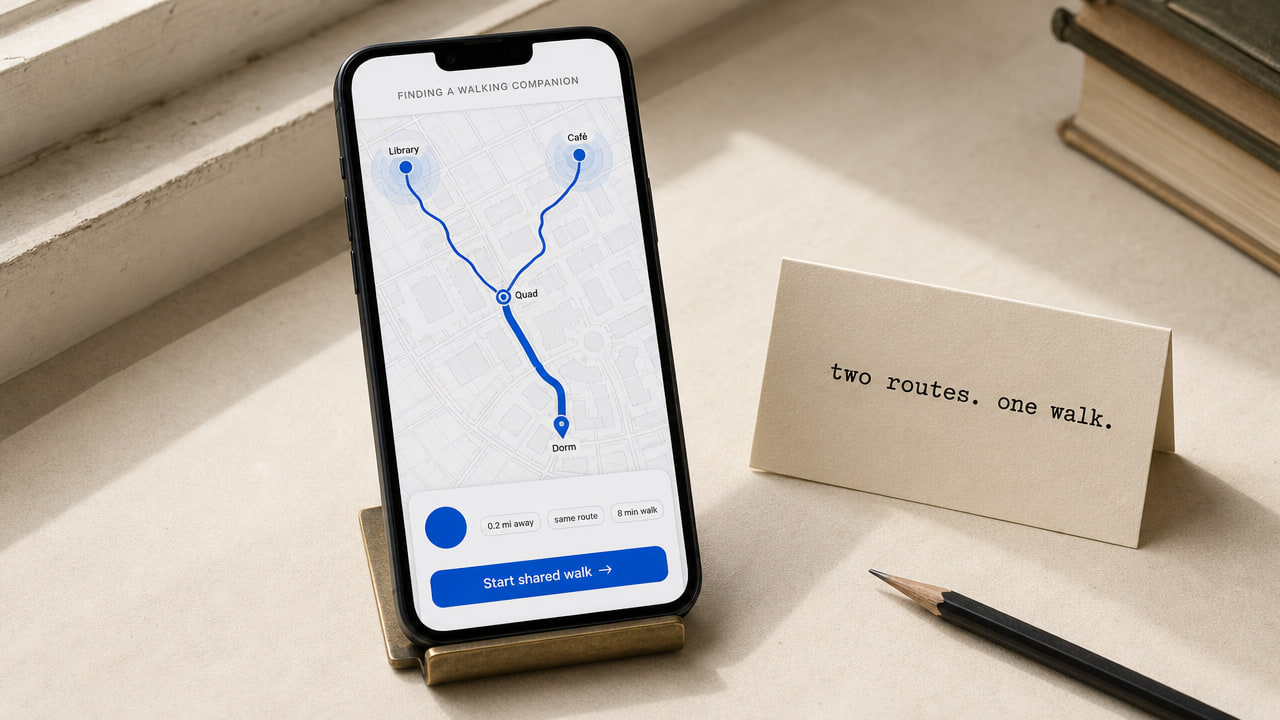
That's what AI matching does. It looks at the population of users in a given area, their start points, their destinations, their departure times, and pairs the ones whose routes overlap meaningfully. The unsafe window of solo walking shrinks to near zero when matching is dense enough.
This is the shift from reactive to proactive. The button still exists. It's just used a lot less because the situations that would trigger it don't happen.
How AI matching actually works.
A modern AI matching system in personal safety has four layers.
Identity verification.
Before matching can happen, both users need to be verified. .edu email plus photo ID is the standard. The matching pool is verified by definition.
Route inference.
When you start a trip, the app reads start point, destination, time, and historical route patterns. The match candidate pool is filtered to users whose inferred route overlaps yours.
Compatibility scoring.
Beyond raw route overlap, the system scores compatibility on factors like school affiliation, gender (for female-only platforms), match history, and current trip stage.
Real-time matching and confirmation.
The two best candidates are notified, both confirm interest, and the trip becomes a paired walk. Both users see live location of the other. Both have shared trusted contacts looped in.
The non-trivial AI work is in steps 2 and 3. Route inference at speed. Compatibility scoring that doesn't take 30 seconds. Dynamic re-matching when one party cancels or a closer match emerges. Most platforms claim all four layers. Few execute all four well.
Where AI adds real value.
Real value. Not marketing value.
Density at scale.
AI matching can pair tens of thousands of users in real time. Manual matching can't.
Pattern detection on walking behavior.
If you usually walk the same route at the same time and tonight you're 30% slower or off-route, smart escalation can prompt a check-in.
ETA prediction for trusted contacts.
Live ETA, updated every few seconds based on movement, is a much stronger signal than she said she'd be home around 11.
Compatibility-aware matching.
Matching with verified peers from your same school, similar walking pace, similar route history. Not random.
Anomaly detection.
Sudden stops, route deviations, or unexpected idle periods can trigger soft check-ins before any user action is needed.
The combination of these features is what makes AI matching apps qualitatively different from share my location apps with marketing language.
Privacy and AI matching.
The honest concern with AI matching is that it requires data. Routes. Departure times. Movement patterns. School affiliation. Privacy posture matters more here, not less.
AI matching with privacy intact.
Five non-negotiables that separate a real safety platform from a data collection operation.
Platforms that nail privacy on top of AI matching are operating at 2026 standard. Platforms that collect and retain everything in the name of model improvement are not.
What AI can't do (yet).
The honest part of any AI conversation. Here's what the technology doesn't do, no matter what the marketing says:
It can't predict intent.
AI can flag a route deviation. It can't tell you the deviation was caused by a threat versus a coffee detour.
It can't resolve a real-time emergency.
AI is better at prevention and detection than response. Once a situation is active, humans are still the responders.
It can't build trust.
A verified peer match is only as trustworthy as the verification system underneath. Bad verification plus good AI equals false confidence.
It can't replace good design.
A well-matched walk in an app with a confusing UI is still a confusing walk. Product design eats AI sophistication for breakfast.
AI matching is a powerful layer in a safety system. It's not the system. The system is verified community plus AI matching plus ephemeral data plus silent SOS plus trusted contact loop. AI is one piece of that.
AI matching, placed honestly.
sidexside is built around AI matching as its central feature, but matching is deliberately placed inside a larger safety architecture. Not pretended to be the whole product.
In practice:
- AI peer matching for verified female students walking the same route. Library to dorm. Party to car. Late-night commute home.
- Identity verification (.edu plus photo ID) before any user enters the matching pool.
- Real-time ETA and trip sharing with trusted contacts, automatically ending when the walk ends.
- Pattern-aware soft check-ins if route deviation or unusual idle is detected.
- Silent SOS as the backup layer for moments where matching and check-ins aren't enough.
- Ephemeral trip data. Matching uses live data. The data clears once the trip ends.
The AI is not a marketing line. It's the matching engine that decides whether the unsafe window opens or closes for any given walk.
The app launches late May 2026. Join the waitlist at sidexside.ai.
AI matching, without the hype.
AI matching has moved from buzzword to product reality in personal safety. The platforms that do it well aren't doing magic. They're doing identity verification, route inference, compatibility scoring, and real-time matching at scale, with privacy posture intact.
The platforms that put AI in the marketing without doing the underlying work are the ones to skip. The shorthand: ask the platform what its matching algorithm actually optimizes for, and ask where the data goes after the trip. If the answer is fluffy on either, the AI is hype.
For questions about how sidexside's AI matching engine works in practice, what data it uses, and how it handles privacy, contact us.
Frequently asked questions.
How does AI matching work in personal safety apps?
AI matching looks at the verified user pool in a given area, infers each user's likely route from start point, destination, time, and historical patterns, and pairs users whose routes overlap meaningfully. Matching is real-time, density-aware, and re-runs as users start, end, or modify trips. Identity verification is the precondition. AI matching without verification is just stranger pairing.
Is AI matching actually safer than picking your own walking buddy?
It's not a replacement for picking a known buddy if one is available. It's a fallback when one isn't. And it works at scale where individual outreach doesn't. AI matching shines for moments when no friend is going your way at the right time, but a verified peer is. The match quality depends on density and verification standards, not just the algorithm.
What are the privacy trade-offs of AI matching?
Matching requires data. Routes, times, school affiliation, occasionally walking patterns. The 2026 standard handles this with ephemeral trip data, on-device pattern detection where possible, strict role separation server-side, and clear consent flows. Platforms that retain everything in the name of model improvement without clear retention policies are taking the data trade-off too far.