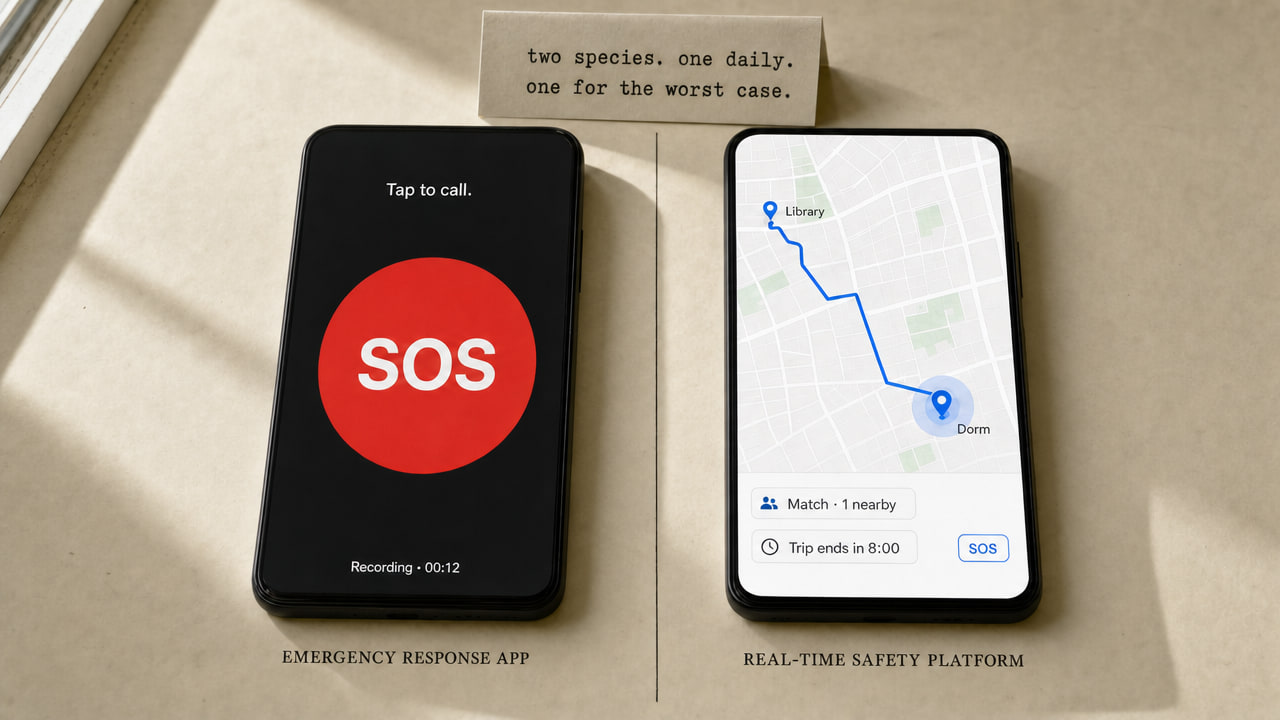
If you've shopped for a safety app in 2026, you've probably noticed the App Store has two species of safety product. They look similar in screenshots. They are not the same thing.
The first species is the emergency response app. Built around 911 integration, panic buttons, dispatch protocols, audio recording, and post-incident documentation.
The second species is the real-time safety platform. Built around live trip sharing, peer matching, walking companions, verified communities, ephemeral location, and silent SOS as one feature among many.
Both are useful. They solve different problems. This post is the comparison most safety app marketing avoids. Because the honest answer for most people is that you want elements of both. The platform that wins is the one that integrates the layers cleanly instead of selling you one and pretending the other doesn't exist.
Context: 1 in 5 women experience sexual assault during college, according to RAINN. The threat window is rarely after the situation has started. It's the walk between two familiar places. Knowing which species of safety product addresses which window is the whole game.
What emergency response apps actually do.
Emergency response apps are optimized for the moment after a situation has started. The core features:
Panic button activation.
Single press triggers an alert.
911 / dispatch integration.
Connects to professional emergency services through systems like RapidSOS.
Pre-set message and contacts.
Alert is sent with a templated message and your last known location.
Audio and video recording.
The seconds around the incident are captured and (sometimes) cloud-backed.
Post-incident documentation.
Timestamped log of the alert, location data, and response window.
These apps are real, useful tools. If something is actively happening, an emergency response app gets you the centralized response system faster than dialing 911 manually. And it builds a documentation trail that matters in the days after.
The limitation: the entire architecture assumes the incident has begun. Everything before the button press isn't this product's problem.
What real-time safety platforms add.
Real-time safety platforms are optimized for the moments before, during, and around the threat window. The core features:
Live trip sharing with trusted contacts.
Real-time, not snapshot.
AI peer matching.
Pair with another verified user walking the same route.
Verified community.
.edu email plus photo ID verification on every user.
Silent SOS.
Trigger an alert without unlocking your phone or making it visible.
Trusted contact loop with layered escalation.
The 2–3 people who'll actually show up for you, alerted in seconds with full context.
Ephemeral location data.
Trip data clears after the trip. No permanent location archive.
The architecture assumes the goal is to keep you out of the unsafe window in the first place. The emergency layer is there as backup. Most users never trigger it because the proactive layer prevents the situations that would.
Side-by-side: the actual comparison.
The clearest way to think about this:
Emergency response apps are about the worst case. They optimize for something has happened, now what. Strong on dispatch integration, audio capture, and post-incident documentation. Less strong on prevention.
Real-time safety platforms are about the daily case. They optimize for the walk home tonight. Strong on peer matching, verified community, and prevention. Most include emergency response features as a layer rather than the headline.
Both can include a panic button. The difference is what happens around it. In an emergency response app, the panic button is the product. In a real-time safety platform, the panic button is the backup of last resort.
Both can integrate with 911. Real-time platforms increasingly do. The difference is whether 911 integration is the strategy or one of several response paths.
If you're choosing one, the right framing is: which system covers the moments that matter most for your specific life?
For most people — especially women, students, and late-night commuters — the daily case is the bigger surface area. The worst case is rare. The threat window before the worst case starts is where the real action lives.
When you need each.
Two honest lists. The right primary tool depends on which window dominates your week.
When the worst case is the realistic case.
Scenarios where an emergency response app is the right primary tool.
When the daily walk is the threat window.
Scenarios where a real-time safety platform is the right primary tool.
For most readers of this post, the second category is the daily reality. The first category is the rare event. Building your safety stack around the rare event and treating the daily reality as secondary is backwards.
What the best setup actually looks like.
The honest answer for most people in 2026:
A real-time safety platform as the daily-use product.
Open it for walks, commutes, late-night transitions.
Emergency response features built into that platform.
The integrated layer handles the worst-case backup.
Native phone emergency features as the absolute fallback.
Emergency SOS on iPhone, Emergency on Android.
Three layers. Daily protective. Integrated emergency. Native fallback. Most legacy emergency response apps only handle the second layer. Real-time safety platforms increasingly handle both 1 and 2, with the native phone features as the third.
A real-time safety platform with emergency response built in.
sidexside is built as a real-time safety platform with emergency response features integrated as one layer of the system. Not as the headline.
In practice:
- AI matching with another verified female student walking the same route. The unsafe window often doesn't open at all.
- Live trip sharing with trusted contacts during the walk, ending automatically when you arrive.
- Silent SOS if something does go wrong. Triggered without unlocking, typing, or making it obvious.
- Trusted contact loop with layered escalation that engages in seconds, with full context. Rather than waiting for a 911 dispatch.
- Identity verification (.edu email plus photo ID). Verified community on both sides of every match.
- Ephemeral data. Trip data clears after the trip ends.
For users who need pure emergency response features, sidexside isn't a replacement. For users who want a daily safety platform that includes emergency response as one of several layers, it is.
The app is live on iOS and Android. Download sidexside at sidexside.ai.
The real choice in 2026.
The real choice in 2026 isn't emergency response app or real-time safety platform. It's which layer is your daily product, and which is the backup.
For students, women, and late-night commuters, the daily product is the real-time safety platform. The emergency response features should be a layer inside that platform. Not a separate app you've forgotten about.
For questions about how sidexside's real-time matching, silent SOS, and trusted contact loop integrate with native emergency response features, contact us.
Frequently asked questions.
Which one do I actually need — an emergency response app or a real-time safety platform?
For most students, women, and late-night commuters, the right answer is a real-time safety platform that includes emergency response features as a layer. Pure emergency response apps are optimized for incidents. Real-time safety platforms cover both prevention and response. The daily case beats the worst case in determining which architecture fits your life.
Can one app do both?
Yes. That's the direction the category is moving. The best 2026 platforms combine real-time peer matching, trip sharing, and trusted contact loops with silent SOS and 911 integration. The unified architecture is more useful than a separate emergency response app. Because you actually open the safety platform daily, while emergency-only apps drift to the bottom of your home screen.
How does 911 integration work in modern safety platforms?
Most modern safety platforms partner with RapidSOS or similar services to route alerts to local dispatch centers. The platform passes location, identity (where appropriate), and any available context. Dispatch can see your live location during the response window. The benefit is professional response. The limitation is the 8–12 minute average arrival time.