Move-in day is the best day of the year. New room, new city, nobody who knew you in high school. Six weeks later, most first-years have their whole social life sorted, and almost none of them were told that the exact stretch they just walked through is the most dangerous of their entire degree.
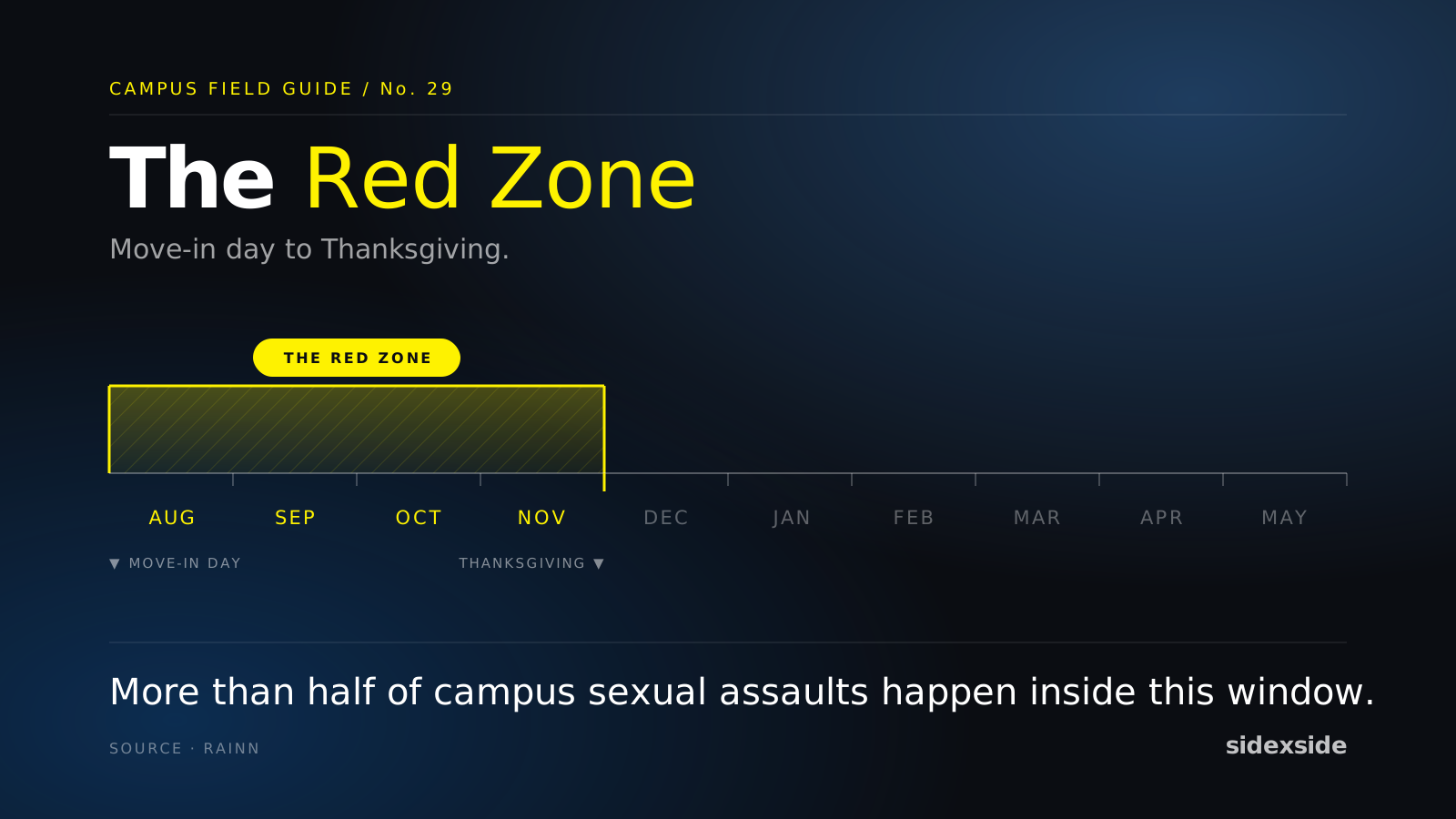
It has a name. Advocates call it the Red Zone: the period from the start of the fall term through Thanksgiving break, when a disproportionate share of campus sexual assaults occur. According to RAINN, more than half of campus sexual assaults happen in August, September, October, or November, and first-year and second-year students are at the highest risk of all.
Let's be real about what that means. The risk is not spread evenly across four years. It is concentrated in the weeks when a student knows the fewest people, understands the campus least, and is most likely to say yes to going somewhere with someone she just met.
This is why the Red Zone exists, which specific moments carry the risk, and what genuinely helps, as opposed to the poster in the dorm lobby.
Why those six weeks are different.
The Red Zone is not a coincidence or a scary statistic without a cause. Four things line up at once, and they only line up in the fall.
Nobody has a network yet.
In September your "friends" are people you met eleven days ago. There is no group chat that notices you left, no roommate who knows where you went, and no one who will realise by 2am that you never came back.
The map is unfamiliar.
You do not yet know which shortcut is fine and which one is a bad idea, where the lighting stops, or how far that off-campus house actually is from your dorm until you are walking back from it.
Social pressure is at its peak.
Welcome week, rush, first parties. There is enormous pressure to go out, stay out, and not be the person who leaves early, and that pressure is heaviest on the students with the least experience reading a room.
Drinking patterns are new.
For many students the first weeks involve unfamiliar environments, unfamiliar quantities, and no established sense of what their own limit is, which perpetrators of opportunity are very aware of.
Put those together and you get a student who is isolated, disoriented, socially pressured, and impaired, all at the same time, in a place she has lived for under two months. That is the Red Zone. It is not about bad decisions. It is about a window where every protective factor a student normally has is missing at once.
The three moments that actually matter.
Campus safety messaging tends to be general. The risk is not. It sits in three specific moments that repeat every weekend of the fall.
The walk there.
Off-campus houses, apartments past the edge of campus, a party address someone texted you. You are going somewhere you have never been, usually after dark, often alone or with someone you barely know.
The moment you want to leave.
This is the one nobody plans for. You want to go, your friends want to stay, and the choice becomes walking back alone or staying somewhere you no longer want to be. Both options are bad, so most people stay.
The walk back.
1am, unfamiliar route, phone at nine percent, possibly impaired, definitely alone. The walk home is the single most predictable risk moment in a first-year's week, and the one campus systems cover worst.
Notice that none of these are solved by a safety poster or a mandatory online module. They are all solved by the same thing: having someone with you, or having someone who knows exactly where you are.
What campuses get wrong.
Most schools do something in the fall. The problem is that the something rarely maps to the three moments above.
Good intentions, wrong timing.
Every tool below is useful. None of them are there at 1am on the walk back.
The pattern is clear. Every traditional tool activates after something has gone wrong, or requires a student to declare that she is frightened. First-years, more than anyone, will not do that. They will choose the risky walk over feeling embarrassed almost every time.
Nobody wants to be the girl who called security. Everybody is fine with walking next to someone going the same way.
What actually helps in week three.
Prevention that works during the Red Zone has to fit the reality of an 18-year-old's Friday night, not an administrator's flowchart.
Company, not an alarm.
The most effective intervention is simply not being alone. Being paired with another verified student walking the same route removes the risk before it starts, rather than reacting once it has.
A network you have before you need one.
The core problem in September is having no one. A verified student community gives a first-year a hundred people going her way on night one, instead of waiting until October to build that organically.
An exit that costs nothing.
The hardest moment is leaving. Knowing there is someone to walk with makes going home an easy choice rather than a social one, which quietly defuses the moment that most often escalates.
Silent help, and people who show up.
If something does go wrong, a discreet SOS that alerts the two or three people who will actually come, with location and context, beats a loud alarm that alerts nobody in particular. Panic buttons alone are not enough.
Proactive beats reactive. Every time. Especially in a six-week window where the entire problem is isolation.
Built for the first six weeks, not just the emergency.
sidexside exists because the answer to the Red Zone was never a louder alarm. It was never walking alone in the first place.
- Real-time peer matching with a verified student walking your route, from the party to your dorm.
- .edu email and photo ID verification so the person beside you is a real, accountable student.
- A female-only verified community, which is the whole point and the thing anonymous apps cannot offer.
- A silent SOS with trusted contacts that alerts the people who will actually show up, with context.
- Location sharing that clears after each trip, so your friends know you got back and nobody keeps a history.
You should not have to survive September.
The Red Zone is not a warning to first-years to be more careful. Nothing about it is their fault, and telling an 18-year-old to text when she gets home has never once stopped anything.
It is a design problem. The risk concentrates in the exact weeks when students have no network, no map, and no easy way to leave. Fix the isolation and the window closes.
Starting somewhere new this fall, or responsible for the students who are? Download or bring sidexside to your campus before move-in.
Frequently asked questions.
What exactly is the Red Zone?
It is the term advocates use for the stretch from the start of the fall term through Thanksgiving break, when a disproportionate share of campus sexual assaults take place. RAINN reports that more than half occur in August through November, with first-year and second-year students at the greatest risk.
Does it only affect freshmen?
No, but they carry the highest share of the risk. The factors driving it, an unbuilt social network, an unfamiliar campus, and peak social pressure, are simply most intense for students in their first term. Transfer students and international students face a very similar version of it.
Are campus escort services enough?
They help, and they are underused. The barrier is social rather than practical: calling security to walk you home feels like escalating, so most students choose the risky walk instead. A peer walking the same route carries none of that weight, which is why uptake is so much higher.
What can parents or campus staff actually do?
Front-load the support rather than the warnings. Make sure a student arrives with a way to find company on a late walk from day one, instead of hoping she builds those friendships before the first big weekend. The gap is the six weeks before an organic network exists.