Sophomore year you move off campus, and it feels like a promotion. Your own kitchen, no RA, a lease with your name on it. What nobody mentions at the signing is that you have just moved outside almost every safety system your school spent your first year telling you about.
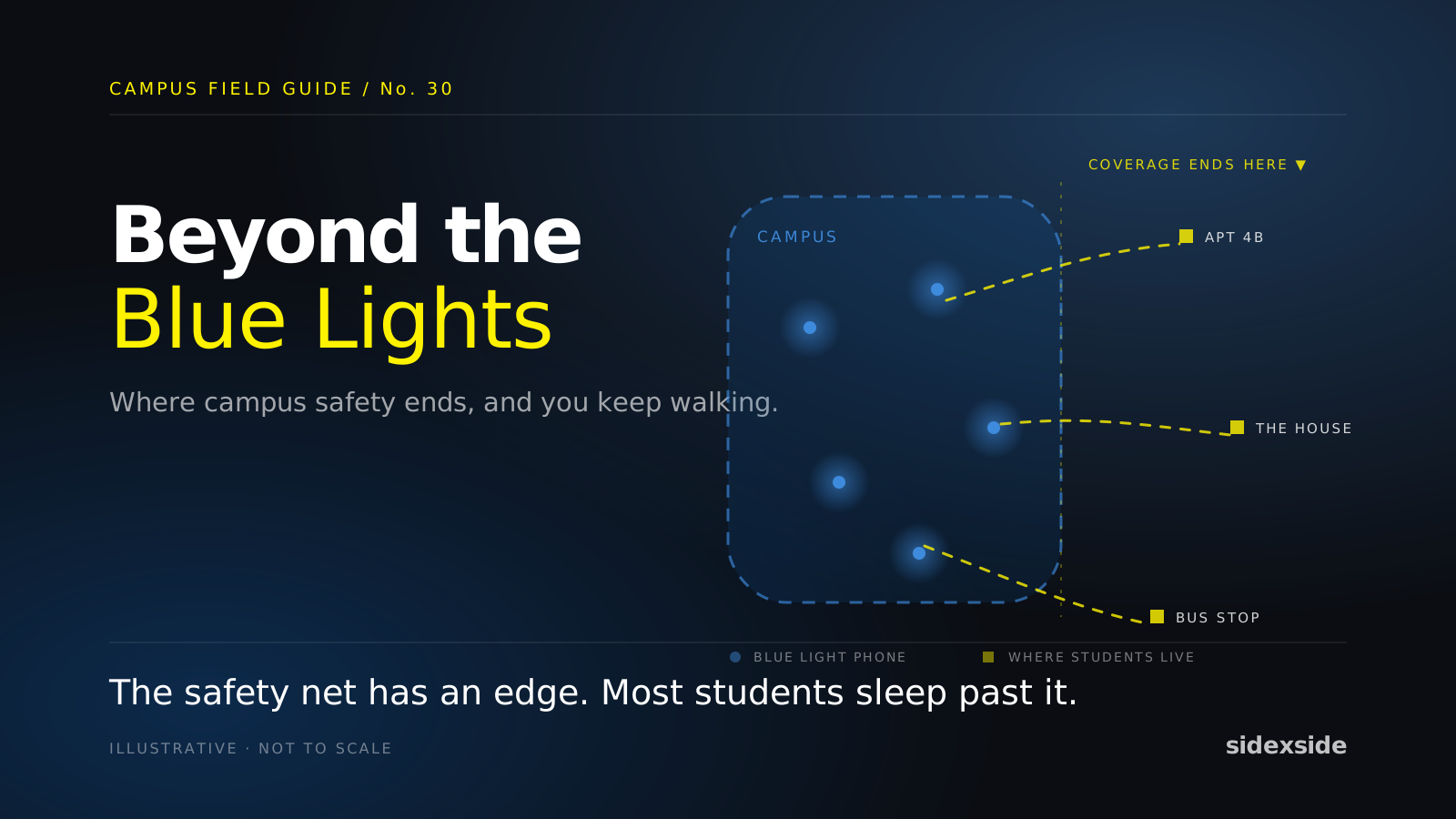
The emergency poles stop at the edge of campus. The safety escort service usually stops there too, or a couple of blocks past it. Campus police authority thins out fast. And the crime statistics your parents read before choosing the school were never counting your street in the first place.
None of this is a scandal. It is a jurisdiction map, and jurisdiction maps have edges. The problem is that student life does not respect the edge at all. You cross it four times a day, and you cross it alone at night more often than anyone plans for.
Here is what actually changes when you move past the line, and what genuinely replaces the things you left behind.
What stops at the property line.
Four separate systems end at roughly the same boundary, and they end quietly. Nobody sends an email about it.
The blue light network.
Those emergency poles are installed on institutional property. Walk three blocks into the neighbourhood where the cheap rentals are and the nearest one is behind you, which is the exact direction you are walking away from.
The escort service.
Most campus walk-home and shuttle programs define a service area, typically campus plus a short radius. Ask where the boundary is and you will usually find your apartment is a street or two outside it.
Campus police authority.
How far a campus force can act beyond its own property varies by state and by mutual aid agreement with local police. What is consistent is that it is not unlimited, and that a call from your apartment goes to a different agency than a call from the quad.
The statistics themselves.
Under Clery Act reporting, schools disclose crimes on campus, on public property immediately adjacent to it, and in non-campus buildings they own or control. A private rental usually falls into none of those, so what happens there never enters the number.
That last one deserves a second read. The safety record a family evaluates when choosing a school is, by design, a record of a geography most of that school's students will not be living in by junior year. It is not dishonest. It is just measuring a smaller place than the one students actually occupy.
The three crossings you make every week.
Off-campus risk is not ambient. It sits in three specific journeys that repeat, and all three run in the same direction: away from lit, patrolled, populated ground.
The library walk.
You closed the library at 1am because the paper was due. The campus part of the walk is fine. The last eight minutes, once you are past the last building and into residential streets, is a different environment entirely, and it is the part you make alone.
The party walk.
Off-campus houses are where the social life is. Getting there in a group at 10pm is easy. Getting back at 2am, when the group has dissolved and you want to leave before everyone else does, is the moment the whole system fails.
The last four hundred metres.
The stretch between the bus stop, the rideshare drop-off, or your parked car and your actual front door. It is short enough that nobody counts it as a journey, which is precisely why nobody plans for it.
Every one of these is a solved problem when you are not by yourself. Every one of them is unsolved when you are. That is the whole shape of it.
The coverage map, honestly drawn.
It helps to see what each tool actually does once you are past the boundary, rather than assuming the campus safety brochure still applies.
What still works, and what quietly does not.
Same tools, different postcode, very different coverage.
Notice the pattern. Every institutional tool is geographic, and geography is the one thing that changes when you sign an off-campus lease. Companionship is the only protection that travels with you.
Every institutional safety tool is tied to a place. You are the one thing that moves.
What to build before you need it.
Off-campus safety is a logistics problem more than a vigilance problem. The students who handle it well are not more careful, they have simply arranged things in advance.
Pick the route in daylight.
Walk home once at 2pm and once at 10pm in your first week. You will find the block where the streetlights stop, and you will never accidentally take that version of the route again.
Have a walking pool, not a plan.
A plan is "text me when you're home." A pool is a set of verified people heading your direction on any given night. One of these works at 1am on a Tuesday and the other does not.
Make leaving socially free.
The most dangerous decision of the night is the one where going home means walking alone. If leaving already has a companion attached to it, it stops being a decision at all.
Know who is actually coming.
Emergency services matter, but the people who reach you in four minutes are the two friends six streets away. They need to know where you are and what is happening, not just that something is wrong. A button alone is not a plan.
Proactive beats reactive. Off campus, where the reactive layer is thinnest, it is not even close.
Safety that crosses the boundary with you.
sidexside was built for the walk the campus map stops caring about. It goes where you go, because it is a network of people rather than a network of poles.
- Real-time peer matching with a verified student heading your way, on campus or six blocks past it.
- Coverage that ignores the property line, because it travels with the student rather than sitting on a pole.
- .edu email and photo ID verification so the person walking beside you is real and accountable.
- A silent SOS with trusted contacts that reaches the people close enough to actually arrive.
- Location sharing that clears after each trip, so getting home safe never becomes a permanent record.
The line is on a map. You are not.
Nobody hands you a briefing when you move off campus explaining which protections you just gave up. The lease is about rent and the deposit. The safety part is left as an exercise for the student.
So it is worth saying plainly: the poles, the patrols, the escorts, and the statistics all end at a line you cross constantly. The thing that does not end at a line is having someone walking with you.
Moving off campus this year, or responsible for students who are? Download or bring sidexside to your campus before the lease starts.
Frequently asked questions.
Does campus security cover off-campus housing?
Usually not, or only partially. Campus police authority and safety escort coverage are typically bounded by the institution's property and the streets immediately adjacent, though this varies by state and by mutual aid agreements with local police. A privately rented apartment several blocks away generally sits outside that line. It is worth asking your school for the actual service map rather than assuming.
Why do off-campus incidents not show up in campus crime stats?
Because of how Clery Act geography is defined. Institutions report crimes occurring on campus, on public property immediately adjacent to campus, and in non-campus buildings they own or control. A private off-campus rental usually falls outside all three categories, so incidents there are absent from the numbers prospective families read.
What is the safest way to get home from an off-campus party?
Leave with someone, and arrange it before you need it. The failure point is almost never the route, it is the moment you want to go and everyone else wants to stay. If company is already lined up, leaving stops requiring a social decision.
Is this only a problem for upperclassmen?
They live off campus in the greatest numbers, but first-years cross the same boundary every weekend to reach off-campus parties and houses. The walk back is identical whether or not your lease is out there.